
Contemporary Fiction
Date Published: August 2018
Publisher: Pearl Button Press

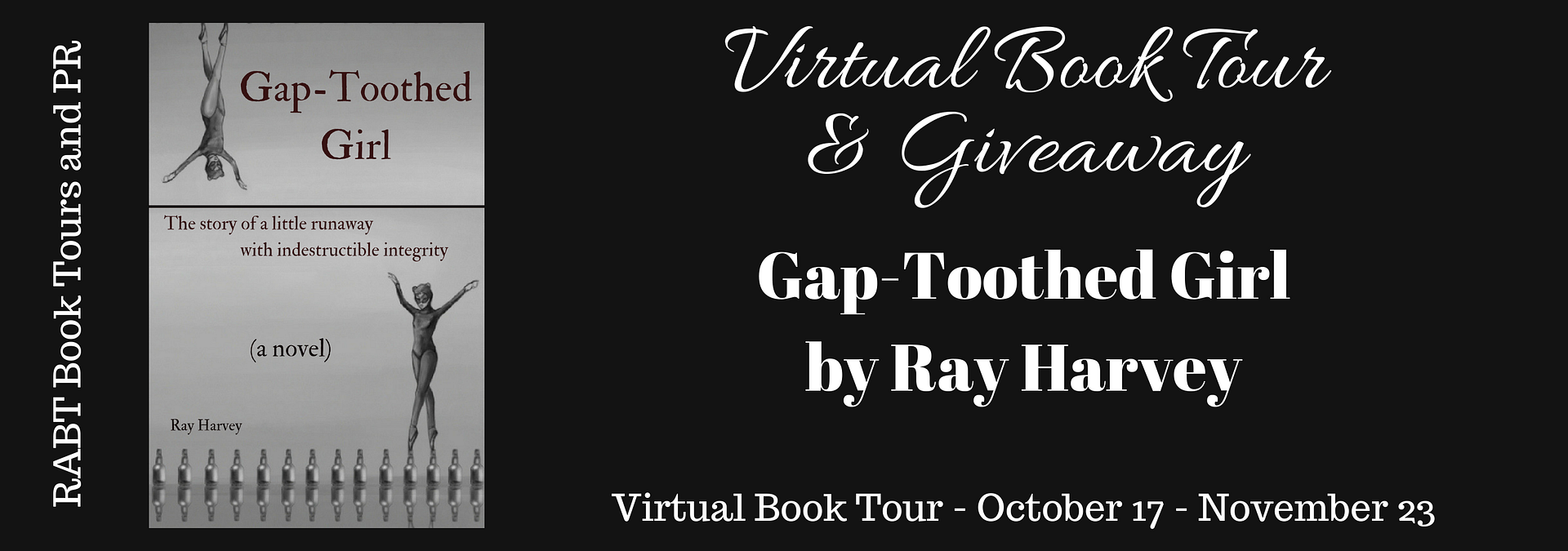
“Tournament night in a sweltering Las Vegas stadium, and the girl with the gap-toothed smile stood bleeding in her ballet slippers.”
Thus begins Gap-Toothed Girl, the story of Dusty May, a Lakota orphan with an iron will, who runs away from the horrific circumstances of her foster home and her foster father — a man of beast-like brilliance and power — to pursue her dream of lightness and ballet, even as her foster father unleashes an army to bring her down.
Part literary fiction, part thriller, part dance story, Gap-Toothed Girl is at its core a tale of human joy and freedom of will — a “relentlessly paced novel” combining “the surreal imagery of Nabokov with the psychological complexity of Dostoevsky” (Fort Collins Forum) to investigate the depths of the human psyche and the indomitable will to succeed, ultimately plumbing the very nature of human happiness and the human soul.
Excerpt
Chapter 3
Thus, this bright autumn morning, she
made her way alone down the leafy lanes that led to his property — so excited
that she several times broke into a sprint. Her maize-yellow tee-shirt read, in
black block-print: RUN WILD.
There were three trampolines behind
the fence, and she chose the one farthest away. A large white sign with
red-stenciled letters said:
PLEASE REMOVE YOUR SHOES
Dusty slipped out of her sneakers and
hopped sock-footed onto the trampoline mat. The daytime moon hung half-crumbled
in the sky above, and the sky was burnished blue.
She began to jump. Her Indian-black
hair lifted and fell. Soon she got her feet underneath her and grew more
confident. She bounced higher and higher until, before long, she felt as though
she were flying. After a while she half came to believe that the only thing
preventing her from making it all the way up to the moon was her will and her
will exclusively.
She was at it for some time before she
realized she wasn’t alone.
Observing her from grass, some twenty
feet away, was the young man she’d watched spellbound through binoculars the
day before.
He appeared suddenly, a friendly
presence with a crooked smile and large brown eyes that were like blots of
melting chocolate. He approached.
She stopped jumping.
He was at least nine years older than
her. Immediately her eyes went to the long and wormy scar that ran the entire
left side of his face clear down his neck, and he noticed her eyeing the scar.
“Admiring my seam?” he said. He cocked
his head so that she might better see the length of it.
“It’s a vacation souvenir I got four
years ago, when I dove into a lake that I didn’t know had rebar in it. I almost
bled to death.”
He leapt lightly onto the trampoline
mat, and she stepped back.
“But I’m still standing!” he said.
He bounced once and landed on his
knees and then bounced back up onto his feet. He did it again. So relaxed, so
natural-looking.
“Now you try it,” he said.
She did it.
He smiled wider. He was one of the
snaggle-toothed, the serene.
He told her his name was David. He
said that he was the son of a woman named Bird, whose husband Wesson Weekly,
his stepfather, owned the trampolines. He told her that he lived in Las Vegas
with his father and stepmother, and that he was here only for a few days, as a
visitor. She could feel his kindness: it radiated from him like a force-field.
Indeed, it was largely this that gave her the courage to tell him she wanted to
learn backflips and front flips, as she had seen him do the day before.
She held his gaze with some effort as
she spoke.
He told her to watch closely, then. He
said for her to pay attention to exactly what he was doing.
She stood off to the side, on the
grass. He jumped. He spoke as he jumped, explaining everything while he did
flips, both front and back. He spoke at length.
He told her that backflips are easier
than front flips. He said that front flips are more dangerous. “Contrary to
popular belief,” he said.
He said that the most important thing
to remember about any acrobatic maneuver is, first, you must fully
decide and, second, you must fully follow through with that decision.
He said you must not overthink it, and
you must not let your nerves get in the way.
He said that anything less than a
total commitment to the move can cause injuries.
She listened to his every word, and
she watched him with lidless fixity. She thought that he was the most beautiful
person she’d ever seen.
He said that, like most things, the
first one you do is the most difficult. He said that after the first one, they
all get easier.
He did backflip after backflip,
slowly, effortlessly, describing to her precisely what he was doing and
explaining to her the whole time precisely how he was doing it.
He told her once again that the most
important thing for her to remember is to not hesitate after she decided to
act. He said you decide and you act.
“And that,” he said, ceasing, “is the
whole secret of life.”
He winked.
“Ready to try?”
She nodded.
“Would you like me to spot you?”
She shook her head.
“Okay.”
He stepped off to one side, onto the
grass, and with an open palm gestured for her to get on the trampoline.
He told her to do what she’d just
watched him do.
She bounced several times, getting her
feet back under her. He observed her. He did not say another word. He could see
her thinking. He could feel her deciding. In an instant, then, as sudden as a
bone-snap, she somersaulted backward and landed, a little overcorrected but
safely, upon her feet. It took her two seconds before she realized that she had
done it. It surprised her how easy it was.
He applauded.
She stood for a long moment,
motionless and winded not so much from exertion as from the pure surge of
adrenaline which came sloshing through her veins like nitroglycerin: the sense
of limitless potential contained within her body and brain, the sudden knowledge
of that, combined with the realization that she and she alone had done
this thing, the touch of fear mixed with courage — it all converged in this
moment and satisfied a secret hunger deep within her, something profound and
poignant which she didn’t know existed until right now, something inexpressibly
private. She felt as though she’d been blasted out of a rocket-launcher.
“I think you’ve got the stuff,” he
said.
About the Author

Ray A. Harvey, novelist, essayist, published poet, athlete, and editor, son of Firman Charles Harvey (RIP) and his wife Cecilia, youngest of thirteen half brothers and half sisters, was born and raised in the San Juan Mountains of southwestern Colorado. He’s worked as a short-order cook, copyeditor, construction laborer, crab fisherman, janitor, pedi-cab driver, bartender, and more. He’s also written and ghostwritten a number of published books, poems, and essays, but no matter where he’s gone or what he’s done to earn a living, literature and learning have always existed at the core of his life.
Contact Links
Purchase Link





thanks for hosting
ReplyDelete